(I'm not really here anymore. Most of the time I'm here. But I figured I'd check back in case anyone missed the memo.)
This September, Viking Children's Books will be publishing an adapted version of The Boys in the Boat, Daniel James Brown's adult nonfiction bestseller. The adult book is fantastic. Really. Read it. But I'm especially excited about this new one because I had the pleasure of working with Mr. Brown, adapting and editing the text for young readers. It's the true story of an underdog crew from the University of Washington, a group of boys who rowed their way to the gold medal at the 1936 Olympics. The characters are unforgettable, and kids are going to absolutely love the story.
I'm also working on a double top secret project with another writer. He's a celebrity, too. The good kind, though. He's smart and funny and passionate about science.
Now, as for detective fiction...here are a few lines I read recently in a Ross MacDonald book, The Ivory Grin.
"Bent over a bin of oranges with my back to the street, I heard her heels on the pavement and felt her shadow brush me, like a cold feather.”
“Large-eared and almost hairless, his head seemed naked, as if it had been plucked. His long face was dimly lit by pale worried eyes. Deep lines of sorrow dragged down from the wings of his large vulnerable nose."
Sure, I could do without the "worried" eyes, the "lines of sorrow" and the "vulnerable" nose. That's kind of cheating, in my mind, when you feed the feeling to the reader. Bellow does this all the time, too, though, so I guess it's allowed. But what if those lines aren't sorrowful? What if this guy is wrinkled because he surfs all the time and gets too much sun? Then they'd be lines of peace and harmony. Criticism aside, I love the shadow as a cold feather above, and the idea that the guy's head looks like it had been plucked is just wonderful. I laughed out loud.
This last one is just plain weird, in a good way:
“His words were soft and insinuating, breaking gently like bubbles between his pink lips. His breath was strong enough to lean on.”
You'd be surprised how difficult it can be to identify an alien. They don't simply trot out before you in their natural form, green, three-fingered, and slimy, with heads measuring at least as tall as their trunks. Last week, for instance, I saw one in a comic book store and he totally looked human. Average height. Sandy, messy hair. Wire-rim glasses. White. Early twenties.
So how did I know he was from another planet? He was moving around a little oddly, stopping and pretending to stare with interest at various items, but none of these behaviors really raised an alarm. Then he walked to the register with a box set DVD collection of the once popular television series Friends. That's when I knew.
Why would a fairly normal-looking young man buy the entire run of Friends? And why now, so long after its cultural moment has passed? Because he's an alien. And I can even tell you where he's from.
Last week, scientists also announced that they'd discovered the two closest habitable planets on record. A habitable planet is one that appears to have a reasonably friendly environment. So, for instance, Venus doesn't count. We'd burn if we tried to hang out there. And it wouldn't be terribly fun to breathe the air. These new planets, on the other hand, appear to be a little more human friendly. And they are roughly thirteen light years away. Which, as you know, is the distance covered by a beam of light traveling for thirteen years.
So here's what I think happened. Right around 2001, or the peak years of Friends, some of the NBC broadcast leaked out into space, racing right along at the speed of light. Thirteen years later, these broadcast waves struck the just discovered twin planets. The aliens, using inconceivably advanced technology, decoded the signals and converted them back into a view-able format. I don't know if they caught an entire episode, a whole season, or just a particularly moving or hilarious scene. My guess, though, is that the entire civilization was mesmerized. Immediately they needed to know what happened to Ross and Rachel, the former stars of the show. So they chose one brave explorer, programmed their wormhole for Earth, and tossed him inside. A few seconds or perhaps even days later I saw him, disguised as a young man, in the comic store. Disoriented, maybe. But focused. He did not wait long to grab that box set.
Star Wars has struck my house. I'm to blame, of course, but I never thought it would become this intense. We've been playing with the action figures for a while now and I'm particularly fond of Han Solo because of his versatility. If you're short a villain, for example, you could always have your existing team of bad guys, like the Joker and Storm Shadow, approach Han with an offer. Because I think we all know that Han would switch sides for the right price. He's a smuggler. Despite what George Lucas wants us all to believe, Han blasted Greedo in that Mos Eisley bar before the alien got the jump on him. Han shot first, and no amount of CGI editing will convince me otherwise.
After the toys came the movies. Episode IV first, then the prequels, because that's good parenting. Those first three are pretty funny as an adult. My favorite scene now is when Obi-Wan tries to worm his way out of his past lies to Luke. The young Skywalker confronts him in Return of the Jedi, pointing out that Obi-Wan said his father was dead. The old Jedi kind of sighs and goes into this rambling discourse, admitting that he was lying without actually owning up to it, and finishing with, "So what I told you was true...from a certain point of view."
Mind tricks aside, that scene kind of got me thinking that Jedis would make good lawyers. Imagine Obi-Wan going up against Colonel Nathan Jessup in A Few Good Men? He would have smoked him.
The one big disappointment of this whole Star Wars obsession is the books. Much of the stuff that's out there for early readers right now is TERRIBLE. The early DK Readers are really abysmal. I can't believe that Lucasfilm let them produce those things. They don't read as though they were written for first graders. They read as though they were written by first graders. And the real tragedy is that these books are popular. Immensely popular. You see them everywhere, and it would have been so easy for Lucasfilm to collaborate with real writers capable of turning out out good books.
This past
Tuesday, on my way to a microbiology conference, I spotted a man on the train
wearing a t-shirt with the word “mentor” printed in large letters across the
back. His pants had fallen down below his waist. The view was unpleasant, and I
felt sad for his mentee.
Some
takeaways from the conference: harmful bacteria can hang around on airplane
tray tables, arm rests, and window shades for days; despite early evidence to the contrary, the microscopic bugs that can cause
Legionnaire’s disease survive in windshield wiper fluid; we all need to open our windows
more; there’s no difference in the fungal population of men’s vs. women’s
public restrooms; never schedule phone interviews about quantum computing
during microbiology meetings.
These past
few weeks I’ve been interviewing experts on wearable medical technology, smart
cars, snakes, and urban sensors, and mostly writing fiction. Here are a few recent
articles:
This is an
older one, about
a Dalek builder, that I never got around to posting. My favorite anecdote,
which did not fit in the final article: At meetings, Dalek builders sometimes
sit inside their creations, drive around, and mingle with each other as alien
robots. They even speak in Dalek screech.
In between
the writing and the talking, I helped my kids put together a pretty sick ninja turtle
zip line in the backyard. Then we got to show it off to a friend of mine who was visiting Boston for the night on business.
He was impressed, I think. My mental or intellectual relationship with this
individual is kind of strange. When I lift my car keys to a subway turnstile or
try to swipe a card to enter my house, I think of him. And when I write to him about one of
these incidents, and the fact that he popped into my head after it happened, he
agrees that he was the right person to tell.
A personal record last week: Ten separate talks, plus eight revision workshops, spread between seven different schools and the lovely Massachusetts Reading Association conference. At the latter I spoke about engaging boys as readers. One of the five or six tricks or techniques I discussed: Never ever, ever, ever talk about your feelings. If the narrator discusses matters of the heart too openly and frequently, the book risks losing the boys. Or most of them, anyway. I don't mean to imply that a great book for boys should be without heart or feeling. On the contrary. Any great book must have heart. But with boys I think it has to be subtle. For instance, here's a little passage from the wonderful Jerry Spinelli novel Maniac Magee: "Maniac
just stood there a minute. There was
something that he felt like doing, and maybe he would have, but the lady turned
and went back inside her house and shut the door. So he walked away.”
He wanted to thank her or hug her. But he'd never admit it. Oh no. And here's another, from Rodman Philbrick's classic, Freak the Mighty: "It’s time to go home, Gram gets nervous if I’m not
back before dark. Everything seems
really great, just like Gwen says, except when I lie down on my bed it hits me,
boom, and I’m crying like a baby. And
the really weird thing is, I’m happy." The emotion comes upon him inexplicably. As a reader, you've probably already guessed that he's happy, since he's made a new friend, but he sure doesn't know, or does not want to admit it, until he's forced to confess, since he's crying and all. Finally, I found the classic My Side of the Mountainin my father-in-law's collection. This novel follows a boy who runs away from his overcrowded NYC apartment to live in the woods of the Catskills. When the main character writes about his first night in the woods, he very reluctantly admits how he felt: "So I sat tight, and shivered and shook - and now I am able to say - I cried a little bit." Much later in the novel, at a happy moment, when the season changes, we get this:
Often I dream about being able to breathe underwater. It
always comes to me as a kind of revelation, as if it’s actually really simple,
and our whole inability to breathe underwater as humans has been a matter of just not doing it
right. The trick is to just sip the air out of the water through pursed lips. That’s all.
Anyway, this breathing vision is common, for me, along with the
dreams about clean, surfing-worthy waves breaking on the street outside my
house, or an office building, but a new one has popped up recently as well. In this new scenario, besides the breathing, I can
also see very clearly underwater, as if I’m wearing goggles, and all I have to
do is just open my eyelids very slightly at first, to form a kind of air
bubble, and then gradually open them wider so that this bubble spreads, forming
a kind of natural lens of air over my eyes.
The dream is so vivid that I’ve tried it a few times in the
pool. And no, it does not work. But I’ll probably keep trying.
Last week, I was deep into a conversation about computer
simulations with a very smart German scientist when he unexpectedly paused. “Greg!” he said after a moment.
“Yes?” I replied. I was worried he’d caught me zoning out.
“Don’t worry, Greg!
This is very difficult! Even many
of my colleagues have trouble understanding this research!”
I thanked him; apparently he sensed my confusion, and I was
very grateful. Scientists aren’t always
that patient or understanding when explaining the intricacies of their
work. He does some fascinating research,
too, so I’m glad he took the time to explain it, and I’ll point to the story in
a future post, after it has been published. In the past few weeks I also spoke
with a few toxicologists, a sports scientist in Norway, an odd pair of
inventive gentleman who conspired to build a very unusual car, and a
brilliantly offbeat artist who designs crazy Rube Goldberg machines. I can’t
really discuss all the stories until they’re published, but here are a few
other recent ones:
Also, here’s an
older one that I never linked to, and should have, since it does kind of
pull together two of my passions, science and basketball. These scientists at
Georgia Tech built a jumping robot and discovered that it’s more efficient for
a robot to perform a short hop before a big jump. One of the engineers then
noticed a video of the basketball star Kobe Bryant doing the same thing in a
famous commercial. I don’t know that I’ve ever been able to reference the NBA
in a science magazine before. So I was pretty excited.
This
is even older, from earlier last year, but it was just so cool. The story
is all about hibernation, but I was particularly excited about the bears.
Apparently, they hibernate in giant nests. Yes, nests.
Imagine walking through the woods in the winter and
stumbling across a massive pile of fur surrounded by a huge pile of brush and sticks? I’d
probably start worrying that I’d stepped into an alternate universe and that
some giant predatory bird was going to blame me for knocking its nest over and then come and pick me up and take me away. Of
course, there’s always the chance that this bird would turn out to be friendly,
and offer to give me rides to different places in exchanges for jokes or funny
poems or beef jerky, in which case I would always try to keep one or a few of
each on me at all times, so that if I was ever stuck, or just wanted to go
somewhere nicer, or warmer, I could call my giant bird friends and get a ride.
Sorry...I thought I was writing about
science. Now I’ve wandered into fiction again. So, while we’re here, or there,
I’ve got a few great quotes from recent readings:
Am I done with the new novel? Yes! Absolutely. I'm done. Or at least I'm probably...sort of done. I mean, I think the characters are all there. The story moves. But the ending might need a little work, and there's a chapter in the middle that's probably a little too long, and I still don't know if I'm quite comfortable with the opening and...no, I'm not done. But I will be. Someday.
And I'll have these pages on the left to thank. The notebook was a gift. It's large and floppy, with a kind of faux leather cover, light brown, and newsprint-like paper inside. For a year I didn't write much in it because of the paper. I'm fairly particular about my paper. When I'm writing fiction by hand, I have to use either a legal pad, because my father writes on legal pads, or the thick, bumpy, really nice paper that comes in really nice notebooks. This one on the left was not up to par. Or so I thought. Then, a few weeks ago, I had the chance to see a rare first edition of Walt Whitman's Leaves of Grass stashed away in the Providence Athenaeum. The paper was very similar to the stuff in my disrespected newsprint. There's a character in the novel who is found of Whitman, and a turtle named after the poet, too, so I took these little connections as signs, and put away the legal pad in favor of the floppy notebook. Plus, the paper is made in Japan and this novel is all about ninjas.
This week I spoke with engineers and scientists about cloud storage and the technological alternatives to testing new cosmetics and drugs on animals. These stories are not related. But they've got me thinking about sheep with too much lipstick and rouge grazing on the tops of clouds or maybe storing their excess makeup in these clouds so that their shepherd does not find them and use them himself. Or maybe they store their makeup in the clouds because they're afraid that if the shepherd finds them then he will realize they are smarter and more image-conscious than he thinks. He'll sit there under the stars and think, "Forget sheep-herding. There's no money in it. What I'll do is take these image-conscious sheep and go on the road. Start a song-and-dance show. With sheep!" Meanwhile, all the poor sheep want to do is hang out and graze and wear their makeup.
No, that's not right. I'll keep those stories separate.
Now for something completely different. Here's an NFL analyst and former quarterback, Trent Dilfer, talking about another quarterback, Terrell Pryor:
"He's putting in the lonely work that it takes to be successful at any position in this league."
The lonely work. I love that idea. And I think there's an element of lonely work to any pursuit or passion. The guy who plays quarterback in front of 80,000 people or the musician who sings before a packed stadium - they put in the solitary work to get to that crazy, crowded point. Unfortunately it appears that Pryor needs to put in quite a bit more lonely work, since he's not having a very good season.
"There's always discovery in the making...the making has to be loose enough and open-ended enough for there to be a place for discovery."
And:
"In the work that I do there's a lot of place for not the unconscious but the non-planned to have a place and to lead to ideas...that's where the art comes from."
This past weekend, at the Rhode Island Festival of Children’s Books and Authors, I had an amazing time talking with a bunch of great authors and illustrators. So, what do writers talk about when they hang out together? Books, naturally, and rainbow loom. And whether one should drop lemon wedges into glasses of water or just squeeze in the juice. And this guy, the Irish novelist Flann O'Brien, on the left. Another writer turned out to be a fan and I don’t often meet too many lovers of The Dalkey Archive. At one point, a few of us were stuck trying to remember the library song from Beauty and the Beast. That's when I knew I was with my kind of people. The
author/illustrator Laurie Keller and I also had a great conversation about the
necessity of working on your weird stuff, the art or writing out there on the
fringes, which is often the material that keeps you inspired. So I’m going to
spend a little time on the adventures of a character named Tim this week. He’s
very odd.
Speaking
of illustrators, a few months ago I met the artist Greg Hildebrandt, who, along
with his brother, created the iconic Star Wars movie poster with Vader looming in the background. At the time I
was actually interviewing an amazing kid named Justin Beckerman, who built his
own one-person submarine, and kind of thinks with his hands. If Justin wants to
understand how a motor works, he doesn’t look it up online. He takes the motor apart,
moves things around, cleans different parts, replaces things, and then just
gets it. The final story is here, and I probably could have written it without
visiting, but I just had to meet this kid. Naturally, he was standing outside
in his driveway taking apart a broken jet ski when I arrived (at night!), and
it was quite a bonus when he took me next door to meet Hildebrandt, his neighbor.
The
artist shared a few great stories about his youth, including the time he ate
crayons because he wanted to know what the colors tasted like, and this little
pearl of wisdom about creative work:
“It’s
not all about inspiration. It’s about slow, steady, forward movement.”
Now
on to the latest installment of Emersonian Reading Series. At the Providence
Atheneaeum, a wonderful library, I read the first few pages of the famous
composer Igor Stravinsky’s autobiography and found this delightful passage: "...one of my earliest memories of sound will seem somewhat odd...I can see it now. An enormous peasant seated on the stump of a tree. The sharp resinous tang of fresh-cut wood in my nostrils. The peasant simply clad in a short red shirt. His bare legs covered with reddish hair, on his feet birch sandals, on his head a mop of hair as thick and as red as his beard - not a white hair, yet an old man. He was dumb, but he had a way of clicking his tongue very noisily, and the children were afraid of him. So was I. But curiosity used to triumph over fear. The children would gather round him. Then, to amuse them, he would begin to sing. This song was composed of two syllables, the only ones he could pronounce...he made them alternate with incredible dexterity in a very rapid tempo. He used to accompany this clucking in the following way: pressing the palm of his right hand under his left armpit, he would work his left arm with a rapid movement, making it press on the right hand." That's right, ladies and gentleman, one of history's greatest composers was drawn to music because of some guy making fart noises. A nice image early in Tom Clancy’s The Hunt for Red October:
"The water was coated with the bilge oil of numberless ships, filth that would not evaporate in the low temperatures and left a black ring on the rocky walls of the fjord as though from the bath of a slovenly giant."
A fragment from a great passage in one of Roberto Bolano’s big books:
"...and he dreamed that to escape the bullets he ducked underwater and let himself be carried along by the current, coming up only to breathe and going under again, and in this way he traveled miles and miles of river, sometimes holding his breath for three minutes or four or five..."
And
here’s the Irish playwright JM Synge, in his memoirs of time spent on the Aran
Islands, noting what sounds very much like an early minimalist running trend:
"Michael walks so fast when I am out with him that I cannot pick up my steps, and the sharp-edged fossils which abound in the limestone have cut my shoes to pieces. The family held a consultation on them last night, and in the end it was decided to make me a pair of pampooties, which I have been wearing today among the rocks. They consist simply of a piece of raw cowskin, with the hair outside, laced over the toe and round the heel with two ends of fishing-line that work round and are ties above the instep."
Is anyone surprised the Irish were early proponents of minimalist running, though? They invent everything first. Finally, after much internal reflection,
I have arrived at an answer to a question a budding writer named John posed
to me earlier this year during a school visit: How do you research a subject
that is entirely fictional? So, to back up, in my talks I stress the importance
of becoming an expert in whatever subject you happen to be writing about.
Cryptography or baking supply chain logistics, for example. But John was confused because he wanted to write about mages and mages don’t really exist. To most people, anyway. So when John first asked me the
question, I suggested gathering as much information as he could from other works of fiction.
Now I’ve got a better idea. John, you
might not like this, as it does mean more work, but I think you have to write
the book you would need to read to write your book. Hmmm....let's try that again. So, to become an expert on
an imaginary person, place, or thing, you have to really think through and
flesh out that subject. If you want to write a book about an alien planet, you
have to build that planet in your head. As for mages, I’d at least sketch out
The Complete History of Mages or Mages 101 or The Guide to Becoming a Mage, or
maybe even all three, before you start writing your book. Look at that Rowling
lady. The imaginary book Tales of Beedle the Bard became so real in her head that
she actually sat down and wrote it out!
Sorry
if that’s disappointing John, but I could tell you were a bright kid, so I’m
sure you’re capable. Oh, and in other news, I found out one of my articles from last year was cited as a kind of honorable mention in the Best American Science & Nature Writing 2013. So that's nice.
When I spotted this sculpture on a lawn down in Providence, I desperately wanted it to get up and walk. For this strange desire I blame Matt Denton. He's the ingenious fellow behind the Mantis, a massive, six-legged ride-able robot. I wrote about his work in Popular Science; the article is here. While we're on journalism, here’s a quote from a scientist I
interviewed recently: “There is no way human beings can
comprehend the deepest secrets of the universe, but everyday we know a little
more. We accumulate more knowledge so we can appreciate our life in the
universe a little more.”
To a young reader named Devin: I'm sorry, but I lost your address. Thanks for the notes. That's so cool that you have a fort down the road from your house and that you discover something new every time you go there. As for the changes to Fish, I like your suggestion. Thimble definitely could have been Thread. But there's something about the name Thimble that works a little better for me, and connects more with the other, not-very-pirate-like side of him.
Some kind of illness knocked me out last
week, and I took advantage of the time off to read both versions of Kerouac’s On the Road. I’m speaking of the
original draft, which he wrote in three weeks on a single piece of paper taped
together at numerous points, known as the scroll, and the finished, published
version that came out several years later. Comparing the two, and reading them back to back, made me want to yell
at his editor. The finished one feels and looks like a
novel, but the original is a madman’s soul spilled out on the page. It is real. I did not feel like I was reading the work of a writer. I felt like I had a seat inside someone's brain. And I love that the
narrator does not refer to himself as a writer in the original scroll. He’s just telling this insane
story that he absolutely, desperately has to tell. The final, published version
is more polished, and has many of the same lines and scenes, but it lacks that
frantic energy.
A few lines great lines, which do turn up in both, I believe:
“I had nothing to offer anybody except
my own confusion.”
“It
was like the arrival of Gargantua; preparations had to be made to widen the
gutters of Denver and foreshorten certain laws to fit his suffering bulk and
bursting ecstasies.”
That
last one reminded me of the great Sappho fragment, via Salinger: "Raise high the roof beams, carpenters. Like Ares comes the bridegroom, taller far than a tall man."
This scene also stood out:
“When Pauline saw me with Neal and
Louanne her face darkened...she sensed the madness they put in me. ‘I don’t
like you when you’re with them.’ ‘Ah it’s allright, it’s just kicks. We only
live once. We’re having a good time.’ ‘No, it’s sad and I don’t like it.’”
You’re mostly seeing this story unfold
from the narrator’s perspective, and he’s generally thrilled and excited about
all that’s happening. Now, though, he lets Pauline speak, and as a reader
you’re left with a better sense of what it might have been like to be around
them. There had to be a powerful undercurrent of
sadness or desperation.
This is a common writer’s trick – the
narrator suddenly noticing someone reacting differently to a scene or sequence.
As the reader you’re exposed to the narrator’s perspective, and he or she is
convincing you that everything is one way, and then they point out that someone’s
crying, and you recall that you’re only seeing this story from one particular
vantage point, and that it might be a wholly different story to the others on
the scene. Look for it. Unexpected tears are everywhere in fiction.
And speaking of roads…I could not throw
away an old plastic shower curtain last week. Just couldn’t bring myself to do
it. Why? Because of The Road. The
insane, post-apocalyptic Cormac McCarthy novel. I have the audio version and
listen to it often and when I was trying to throw out the old curtain I kept thinking how the man and the boy really could
have used that plastic sheet while they were wandering around, to use as a roof
or cover from the rain. So it’s in my garage. Stuffed in a corner. In case
there’s an apocalypse.
This well-dressed gentleman on the left greeted visitors to the Martha's Vineyard Agricultural Fair this summer. Who would have thought the grim reaper would go in for a strapless dress?
The summer was moderately hot, but our
local power company recently informed us that we are far more efficient than
our neighbors, and it’s only right to thank Gabriel Garcia
Marquez. Ever since reading this passage from Love in the Time of Cholera -
“…in
the end they were convinced of the merits of the Roman strategy against heat,
which consists of closing houses during the lethargy of August in order to keep
out the burning air from the street, and then opening them up completely to the
night breezes.”
-
we have been using the technique at home.
In
the past few weeks, I spoke with various experts about cryptography, neutrinos, viruses, and the process by which bread, rolls, and other freshly baked goods move from ovens to
delivery trucks. Surprisingly fascinating. In fact I’m embarrassed to confess
that I found the baking supply chain stuff more interesting than the secret
sharing. Perhaps this was due to degree of difficulty.
Recently
we took our kids fishing for the first time, and in doing some reading
beforehand I came across this line from the nature writer Ellington White:
“I
have never yet caught a fish on a first cast, nor have I ever made a first cast
without thinking I would catch a fish.”
The
kids were surprisingly patient and eventually pulled a few snappers out of the
bay. Here’s a very different quote, from a physicist I recently spoke with
about the challenges of communicating science to the public:
“The
language and the concepts are built on so many layers. It's just not like
music. You can know nothing about music and still appreciate the song. Science
is much harder that way.”
One
of our neighbors recently had their house painted. The painters posted a sign
with the following words outside: "Led Paint. No Drinking! No eating!"
When
I noticed this misspelling - LED is the
acronym for light-emitting diode, a cool and bright little light source – en route to work, it set me thinking
about a paint filled with these little lights, and what would happen if you
were to ingest it. Would your stomach shine? Would bright light rush out from
your nostrils, mouth, and ears? After a moment or two spent imagining that, I
started wondering why the painters felt the need for that sign. Had some
desperately thirsty neighborhood flaneur drank their paint before? Had he or she mistaken it for a container of almond milk, perhaps?
Here’s
a good quote from the dog in those movies with Charles
Grodin:
"Don't
only practice your art. Force your way into its secrets."
Speaking
of art, there has been progress on the art side of the soda bottle book. I hope
to have more updates soon.
And, finally, a correction, and a writing lesson. In
my first children’s novel, Fish, the
main character tries goat milk for the first time and describes the flavor as
somewhat grassy. We are all different, and I suppose someone could draw that
conclusion from a sip of the stuff, but I recently bought a pint and tried it
with my kids. We concluded that it is actually quite creamy, with a more tangy
ring to it than regular milk. I don’t know that my uninformed description in Fish damaged the book substantially –
Saul Bellow wrote
a novel about Africa without setting foot on the continent! – but given all
my prognosticating about the importance of becoming an expert, I feel it’s only
right to admit my error.
Maybe
in a Fish sequel I’ll have him revise his
assessment.
On Monday night, after an insane thunderstorm, a strangely
beautiful yellow light shone in through the windows around dusk. The
houses and trees across the street get the best light at that hour so I went outside
to look at them. The yellow light was everywhere and the most incredible
rainbow arched perfectly across the sky. This rainbow was thick. Honestly. If I had a spoon with a long enough handle I'm convinced I could have scooped some out. Would it have tasted like sherbet?
I don't know, but every single color of the spectrum was clearly delineated. The sky inside the arch was bright
blue and to the right of the right arm of the rainbow it was several shades
darker. There was a faint second rainbow as well, which you can kind of see in the photo above. So I grabbed the half-sleeping kids out of bed and they asked if we’d find a
pot of gold. Which reminds me...
Both of my daughters found a four leaf clover this week. One
through determination, the other through luck.
I stumbled across a great cartoonist. His work is here.
At night I’ve been reading the Irish writer Edna O'Brien’s
memoir, Country
Girl. It’s wonderful so far. I became stuck on this sentence, though: "It
was the first time that I came face to face with madness and feared it and was
fascinated by it." I really wanted her to add another “I” before “feared
it.” But that would alter the meaning; she had probably come face to face before and not feared it. Her recollections of a farmhand named Carnero are wonderful.
The illustrator Katherine
Roy and I are working to come up with some titles for the soda bottle book.
The working title had been BOTTLE OF POP. But that does not get to the fantastic
journey element of the story. So we’re still thinking.
In doing some research for the ninja novel I read an
incredible story about an ancient samurai. It’s at the end of a battle. This
samurai sees another warrior fleeing across the river. He calls him a coward
and challenges him to stay and fight. The other warrior comes back. The samurai
defeats him and sees that he is barely older than a boy and resembles his son.
He wants to let him go, but other samurai are coming. They will kill the boy if
he does not. So the samurai kills him, granting him a more noble death. Then he
looks inside the young warrior’s satchel and finds a flute. He retires his sword
and never kills again.
That’s how I remember it, anyway. I could have messed up
some little details, but the one I clearly remember is the flute. Who would
think he’d find a flute? It’s such a gentle, peaceful, human object. And it
really shows the power of detail in a story.
Sometimes when I become derailed at the computer, and find myself reading something unrelated to the task at hand, I close my
eyes and remain in place for five or ten seconds. That usually works. Soon enough I refocus.
During one of these derailments I found an
amazing story from 1966 about Celtics legend Bill Russell redesigning the
basketball shoe and insisting it be affordable. What a change from today’s
stars. He even redesigned the tread on the bottom to make it easier to stop
short. The sports world needs more people like him.
And a few quotes from the week’s readings...
A biography of TS Eliot by Peter Ackroyd:
“Eliot could, as it were, pick up a poem where he had left
off. He had an extraordinary gift of synthesis so that what seems to be one
poetic persona, or one melodic shape, is in fact the result of compression and
the selective rendering of otherwise disparate materials.”
A few years ago I met the writer Louis Auchincloss and he
told me he had the same ability. He could work on a story while sitting in
court, waiting for his case to be heard, then switch into lawyer mode when his
turn came, and promptly pick the story back up where he left off while riding
the subway back to his office. I’m not so lucky. It takes me some time to
return to the world of the story if I’ve been away.
45. “Then in the summer of this year he travelled to Munich,
where he completed ‘The Love Song of J. Alfred Prufrock.’ He transcribed it
into his notebook and then forgot about it. Conrad Aiken said that he had been
‘heartlessly indifferent to its fate.’”
Ah, but this makes sense! He wrote something great. He was
satisfied. He expelled the story and the idea and the emotion from his head and
his heart and got it all down on the page. When you do that well enough,
publishing is an afterthought. It’s business. It’s nothing.
And a quote from Dr. Seuss, from the book The Cat Behind the
Hat:
"If I can be of
influence to one child in this great vice-ridden country, my life, I feel, has
not been lived in vain.”
A minor revelation this week. I realized I’m not one of
those people who’s going two hundred miles an hour with his head down all the
time and needs to slow down and stop for a while to smell the flowers. My
problem is that I’m always stopping to smell the flowers. Not literally. I’m
allergic to most flowers, so if I stopped to smell them all the time, I’d spend
half my life sneezing. I’m speaking generally. Trees, faces, clouds, a peculiar
stain in a rug or cool old rusted spiral staircase outside a building – these kinds
of things are always grabbing me, making me stop and think. Often they send me
off on some strange, high-speed train of thought that rips along and drops me off somewhere in, I
don’t know, the Crimea. Surrounded by unicorns. And people drinking tea brewed in samovars. I dream up whole new stories, start writing them in my head, then
remind myself, 'No, no, no. You have to focus.'
A case in point: This week, I visited the Boston Museum of
Fine Arts to do some research. They’re running an amazing exhibit on samurai,
and those legendary warriors are part of the focus of my next novel for kids.
So this is not exactly work, or not in the way most people think of work, but
for me, this was serious business. I was there to learn. On my way to learn, though, I cut through the courtyard and spotted this unintentional exhibit on the brick walls. A tapestry
of ivy waving in the wind like the glassy surface of the ocean brushed by the
first hints of wind. Here’s my little video of the scene:
I was transfixed for a while. I don’t know how long. And
then I reminded myself: Stop smelling the flowers! Back to work!
Eventually I recovered my focus, but the day kept trying to distract
me. Walking home from the train station, I passed by a local construction
worker, a big man who lives around the corner from me and walks with great
heavy strides in big, worn old boots. He was sitting outside a small house that
looked like it doubled as a day care center. His shirt was off. He was sitting
in a lawn chair and seemed to be sunning himself. I believe he was eating a
brownie and there was a plastic kiddie pool at his feet. “The Bruins are on
tonight!” he called out to me. We’ve chatted before, but he was entirely out of
context there on the lawn. I didn’t expect him to speak. So I stuttered a
response. “Yes!” I said. “Go!”
He wasn’t supposed to speak; he was supposed to act like the exhibits I'd just seen at the museum. He was supposed to sit there
quietly and let me walk off and conjure some kind of short story.
A few hours later I passed a man sitting on a bench outside a bank. He, too, was entirely out of place. He looked French, and people don’t
ever look French in my town. He wore a jacket with thin lapels. He sat
straight-backed, wearing stylish glasses. A funny little canvas pouch lay beside
him on the bench. I averted my eyes and headed for the ATM. When I came back
out he was smoking a pipe. A pipe! Who smokes a pipe? On a bench in the middle
of a suburban town where you’re always supposed to be going somewhere?
I'll tell you. Here’s my theory. He’s a French physicist. Maybe from the
future. He was running a little experiment in his lab and everyone told him he should really wait for human trials but he had so much confidence in himself and his theories that he figured he'd give it a try and so he activated his machine and stepped through a
wormhole and popped out on the other side in suburban Massachusetts in 2013. Stumped,
and perhaps stuck, he decided the only thing to do would be to stop and enjoy a
pipe while devising a strategy for returning to the France of the future.
There was also a sunburned little man with curly red hair
trying to open the doors of several neighborhood banks. They were all locked. He
looked desperate, ready to rob one.
The samurai exhibit was amazing, by the way. Absolutely
stunning. They wore bear fur on their boots. Yes, bear fur.
This week I wrote about vegan crisps, quantum cryptography,
child psychology, submarines, and samurai. Not all at once, though. And I read. Randomly and widely and incompletely. In reading about the new Hopper exhibit at the Whitney
Museum in NY, I was excited to learn that he created many, many studies for his
masterworks. I guess I never thought about painters creating drafts, but it
makes perfect sense. A writer can’t be perfect on the first attempt. Why would
a painter be any different? The exhibit includes 52 studies for "New York
Movie" and 19 for "Nighthawks." That’s quite a few drafts!
Some quotes from the random readings this week:
“Chickens are categorized as birds by zoologists, as Sunday
dinner by families, as a commodity by investors, and as a source of salmonella
infection by pathophysiologists. Each categorization has a useful purpose.” - Jerome
Kagan
“The measure of value of a hypothesis...is not its
plausibility or compatibility with a subset of facts, or its presumed validity,
but its heurestic potential - how much it suggests for the next stage of
investigation.” - Theodore Bullock
I’m sure there’s context to this next quote, but I’m not
aware of it. Following the Emersonian model of reading, I picked the memoirs
Ulysses S. Grant off the shelf at the local library, opened to a random page,
and read this:
“I am not aware of ever having used a profane expression in
my life; but I would have the charity to excuse those who may have done so, if
they were in charge of a train of Mexican pack mules at the time.” – Ulysses S.
Grant
After reading that delightful line I put the book back on
the shelf. What more could General Grant possibly teach me?
Earlier today, at a great school here in Massachusetts, I spoke with a few hundred kids about reading, writing, science, and everything in between. At the start I was telling them how I love writing stories about smart, slightly weird people building weird, fantastic things. We discussed fast furniture and homemade Iron Man suits, but here are two other recent examples, both from Popular Science.
In one case, a group of young engineers converted an actual go-kart park into a live, realistic rendition of the video game Super Mario Kart. The technology, based around the FIRST Robotics Competition Kit, is amazing, but my favorite part of the story is how they walked into the go-kart park in their white lab coats, introduced themselves to the manager, explained their goals, and asked if they could use one of his carts. Amazingly, the guy agreed. For more, read the story here:
And here's another wonderfully odd one. An engineer named Jason Bell - who also built an automated tow rope for his kids so they don't have to trudge through the snow up their backyard hill while sledding - designed and constructed a human catapult to launch BASE jumpers off a bridge. I know. It sounds insane. But Bell was incredibly careful and paid a great deal of attention to safety. That story is here:
This Sunday at 6:30 EDT, in advance of the 101st anniversary of the ship's demise, I'll be hosting an online interactive chat about Titanic through a very cool new platform called shindig. It's pretty simple. When you sign in, the page turns into a beautiful library, and my bearded mug sits in a medium-sized window in the middle. I'll have some slides in another little window next to me as I talk about Titanic and how I went about writing and researching Dangerous Waters. You can ask questions via chat or texts or even raise your hand so that we can talk directly to each other.
I'll also run a trivia contest, and I'll send the winner a free signed copy of the book.
Now on to other news. I visited a great school in New Hampshire last week, and in the flow of the talks, I asked one of my favorite questions: Where do you write?
As usual, the kids were reluctant to admit to any odd spots, but once a few classmates revealed their own creative hide-outs, they were all thrusting their hands in the air. Their answers ranked right up there with some of the best. My favorites:
A young man named Sebastian detailed the merits of a small, crater-like hole in his backyard. The hole is large enough for him to sit in comfortably and not terribly clean. Yet Sebastian is so dedicated to this writing spot that he even dug out after the big snowstorms this winter.
Ivy talked about how she used to sneak into the shed at her Dad's house. The space was dark and quiet and she sat on the floor between to old rusted bikes to work on her stories.
Finally, Jason. He's a tall sixth grader, and his teacher tells me he's a great writer. Jason talked about how he used to climb under his Dad's van out in the driveway. He'd lie on the pavement and write, then scurry out as fast as he could if he heard the engine start up.
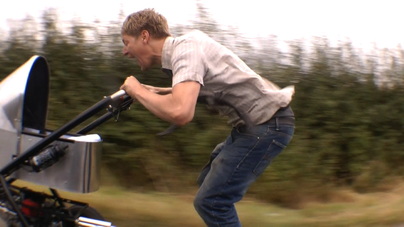
Colin Furze, a plumber and world record chaser, built the world's fastest baby stroller when he found out his girlfriend was expecting their first child. Don't worry. There is no baby in the carriage below, and he never races with his infant son, but the stroller can accelerate up to 53 miles per hour.
I interviewed Furze for Popular Science, and you can check out the full story for details of the build and more. Whenever I interview someone like Furze, there's always way more great material than I can fit in a short piece, and that was the case once again.
For example, Furze has become somewhat famous for his daring record attempts, which also included setting the world's largest bonfire, yet he still works as a plumber. Now, though, when he makes a local house call, he's often recognized. His reputation doesn't exactly soothe his customers, since they're worried he's going to want to do something strange with their toilet. "You'll go and look at the toilet," he says, "and then they'll say, 'I just want you to fix it, I don't want it to go anywhere or catch fire.'"
But a flaming, speeding toilet would be kind of cool....no?
The paperback edition of Dangerous Waters: An Adventure on Titanic is out today, and while I'm not normally fond of exclamation points, I believe this event deserves one, so....! And again! The novel centers on Titanic passenger Harry Widener and his personal copy of a very rare, expensive, and unusual book. Before he sailed, Widener visited a book dealer in London named Bernard Quaritch. He bought a number of volumes, one of which was a 1598 edition of Sir Francis Bacon's Essaies. And he treated this one differently. The New York Times reported on this story in June of 1912, several months after the sinking. In the article, Quaritch says that as Widener was leaving, he pulled the recently purchased copy of the Essaies out of his pocket and said, "If I am shipwrecked, you will know that this will be on me." I spent months researching the life of Harry Widener, reading his letters and inspecting his books, but this story is what prompted me to write Dangerous Waters. My obsession with water, which kids are always asking me about, probably factors in as well. Oh, and I was once on a sinking ship, too. But we climbed off and onto another boat before ours went down.
Of course, the book is fiction. Several of the main characters are entirely invented, or at least borrowed form the manifest of my own life, and not that of the ship. Here is the official plot summary, which I love:
A stowaway, a stolen book, a murderous villain: an adventure on the most famous shipwreck in history.
The great ocean liner Titanic is preparing to cross the Atlantic. Onboard is a sinister thief bent on stealing a rare book that may be the key to unlocking infinite treasure; a wealthy academic traveling home to America with his rare book collection; and Patrick Waters, a twelve-year-old Irish boy who is certain that his job as a steward on the unsinkable ship will be the adventure of a lifetime. In Dangerous Waters, disguises, capers, and danger abound as the ship makes its way toward that fateful iceberg, where Patrick will have to summon all his wits in order to survive.
Look for Dangerous Waters at your local bookstore, online, or at your school's Scholastic Book Fair!
I apologize for that last exclamation point. You must understand, though: I'm excited.
When I realized that my Friday afternoon talk at Bigelow Middle School was the last thing standing between 200 kids and their winter vacation, I was a little nervous. I was counting on a full scale revolt. Or at least a round of restless twitching in the audience. After a few stories about dinosaurs, fast furniture, flying cars and brain surgery, though, the students settled in just fine.
There were more than a few young writers in the crowd, and in case they're reading, I'd like to follow up with several of them:
To the two boys who were about to show me your funny story: I'd love to read it. As I told you, that's how I started out as a writer. My friends and I spun together ridiculous little tales in between class.
To the girl who wanted me to complete her story: We talked about this already, but that's your story, and you should finish it! I'm sure you'll do a better job of it than I could.
To the amateur ninja expert: Thanks for asking about my still-in-the-works ninja book. As we both know, ninjas were known as shinobi, and they didn't always dress in the black costumes we see today. They disguised themselves as farmers, merchants, and other everyday folk. In truth ninjas were more like spies than warriors. All these kinds of historical details will be part of the book, so check back here for updates, and thanks for coming up to say hello.
Finally, Mr. Mogenson, I think you should wear that jacket every day. And thanks for inviting me in to your wonderful school!
Thank you to the fifth grade students and teachers at Martinson Elementary School for inviting me in for a few wonderful workshops earlier this month. I'm still waiting to see how your stories turn out! There were some great ideas, including a daring window entrance, hovering helicopters, and an octogenarian villain. The sensory details you all came up with were fabulous as well.
Given the recent blizzard, and the days off from school, I'm hoping a few of you managed to finish. (Although I imagine the tree lovers among you couldn't climb up to your favorite writing spot.) If you do write those last few lines, don't forget to send me a copy. And remember: revise, revise, revise.
A short but interesting story in Discover magazine about whether the Voyager 1 spacecraft has reached the edge of the solar system, plus some news about the nearly ancient Pioneer probes. I couldn't fit this into the piece itself, but a few of the scientists noted that the real news here might be that these spacecraft are still working. They were launched in the 1970s and designed even earlier. That's pretty amazing engineering.
What did I forget? Ah, right, the story. Read it here.